
Introduction
For many amateur radio enthusiasts (ham radio operators), working in the 40-meter (7 MHz) band offers an ideal balance between medium- and long-range communications. However, one major challenge is the required antenna size – the physical length of antennas for this frequency is typically very large, especially when using conventional dipole antennas.
For example, a half-wave dipole antenna for 7 MHz requires a total length of approximately 20 meters, which is clearly problematic for operators with limited space. This is where the concept of a shorted antenna becomes a practical solution.
What is a Shorted Antenna?
A shorted antenna, also often called a loaded antenna, is an antenna whose physical length is shorter than its original resonance length. To maintain resonance at the operating frequency, this antenna uses inductance (coil/loading coil) or additional capacitance to “extend” the antenna’s electrical length.
In the context of the 40 meter band (7 MHz), this antenna can be made with a much shorter physical length – for example, only 6-10 meters – while still being able to work efficiently at that frequency thanks to its matching components.
Working Principle
When an antenna is shorter than half a wavelength, the capacitive reactance increases. By adding a loading coil at a specific point on the antenna element, this reactance is compensated so that the antenna can return to resonance at the target frequency.
There are several common coil mounting positions:
- Base loading (at the bottom of the antenna) – easier to build, but with the lowest efficiency.
- Center loading (in the middle of the antenna) – a compromise between efficiency and simplicity.
- Top loading (near the tip) – highest efficiency because the maximum antenna current is at the bottom.
Advantages of a Shortened Antenna
- More compact size: Ideal for homes with limited space, apartments, or portable stations.
- Easier to install: No tall masts or long cable runs required.
- Suitable for mobile/portable setups: Widely used in vehicles or field operations.
- Optimizable: With measurements and tuning, performance can approach that of a full-size antenna.
Limitations and Challenges
- Lower efficiency than full-size antennas, as some power is lost in the coil resistance.
- Narrow bandwidth, requiring retuning if the frequency shifts too far.
- Design is sensitive to environmental factors, such as mounting height, soil type, and objects around the antenna.
Example of a Shortened 40M Antenna Design
One popular design is the loaded vertical 40M antenna: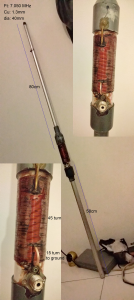

- Vertical length (total): ±1.5 meters
- Loading coil at the feeding point (see picture for details)
- Material: Aluminum tubing or copper wire
- Matching: Using a tuner or tap coil for low SWR
This design is capable of producing quite good performance for medium-range (regional) communications and can sometimes reach DX if propagation conditions are favorable.
Conclusion
The shortened 40M band antenna is a smart and efficient solution for amateur radio operators facing limited antenna installation space. While its efficiency is not as high as a full-size antenna, with good design and proper tuning, this antenna can still deliver satisfactory performance.
Whether for small base stations, portable setups, or urban operations, this type of antenna offers an ideal compromise between size, performance, and ease of installation.